
Many English learners ask whether “even though” is one word or two. The standard form is always two words: even though. “Eventhough” is a common misspelling. Use even though to introduce a dependent clause that contrasts with the main clause, as in: “Even though it was raining, we played football.”
Comparison Overview
“Even though” is the correct two-word conjunction; “eventhough” is a misspelling. Both forms may look similar, but only the two-word phrase is standard English.
- Even though is the correct two-word subordinating conjunction used to introduce a contrast.
- Eventhough is generally considered a misspelling of even though and should not be used in formal or standard writing.
Whether you’re writing an essay, email, business report, or social media post, choosing the correct form improves clarity and professionalism.
| Feature | Eventhough | Even Though |
| Correct English | No | Yes |
| Part of Speech | Not a standard word | Subordinating conjunction |
| Formal Writing | Incorrect | Correct |
| Informal Writing | Avoid | Correct |
| Dictionary Entry | No | Yes |
| Meaning | Misspelling | Even though |
Definition of Eventhough
Eventhough is not a recognized English word. It is simply a spelling mistake where the two-word phrase even though is incorrectly written as one word.
Many learners accidentally write eventhough because the phrase is often spoken quickly, making it sound like a single word.
Example (Incorrect):
- Eventhough it was raining, we played football.
Correct Version:
- Even though it was raining, we played football.
Definition of Even Though
Even though is a subordinating conjunction that introduces a contrast between two ideas. It means even though, although, or although it is true that.
It connects a dependent clause with an independent clause.
Examples:
- Even though I was tired, I finished my homework.
- She smiled even though she felt nervous.
- We enjoyed the picnic even though the weather was cold.
Main Differences Between Even though vs Even Though
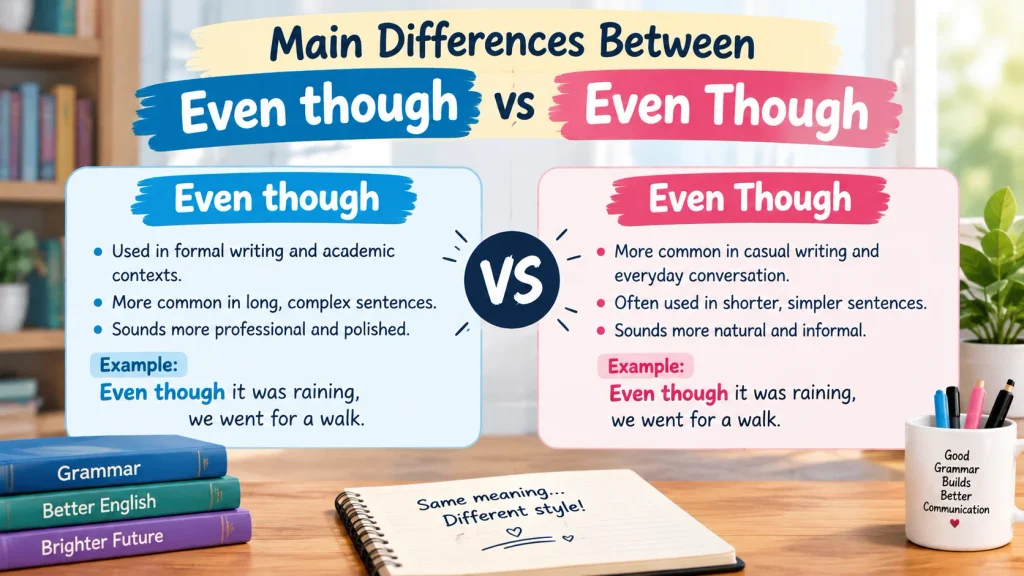
The biggest difference is simple: one is correct, and the other is not.
| Aspect | Eventhough | Even Though |
| Status | Misspelling | Correct phrase |
| Meaning | None | Even though |
| Grammar | Incorrect | Correct conjunction |
| Dictionaries | Not listed | Listed |
| Recommended Usage | Never | Always |
Key Differences
- Even though consists of two separate words.
- Even though should always be corrected.
- Only even though is accepted in academic, professional, and everyday English.
- Grammar checkers usually flag eventhough as an error.
Why People Confuse These Terms
People often confuse these terms because:
- They are pronounced very quickly in conversation.
- Many learners assume it should be written as one word.
- Typing habits sometimes combine separate words.
- Spellcheck may not always catch the mistake immediately.
A simple rule is to remember that it is always written as two words.
Comparison Table
| Question | Correct Answer |
| Which form is grammatically correct? | Even though |
| Is “eventhough” a real English word? | No |
| Can “even though” start a sentence? | Yes |
| Is it suitable for formal writing? | Yes |
| Should “eventhough” ever be used? | No |
Grammar Guide
Even though is a subordinating conjunction.
It introduces a dependent clause that expresses contrast.
Pattern:
Even though + subject + verb, main clause.
Example:
- Even though she studied hard, she failed the test.
How Each Term Is Used in Sentences
Eventhough
Incorrect:
- Eventhough I was busy, I helped him.
Correct:
- Even though I was busy, I helped him.
Even Though
Correct patterns:
- Even though + subject + verb, clause.
- Clause + even though + subject + verb.
Examples:
- Even though it snowed, school remained open.
- We continued working even though we were tired.
Common Mistakes Learners Make
- Writing even though as one word.
- Confusing even though with although.
- Forgetting the space between the words.
- Using even though without a complete clause.
- Thinking it functions as a preposition.
Simple Rules to Remember
- Always write even though as two words.
- Think of it as a phrase, not a single word.
- It introduces a contrast.
- It should be followed by a complete clause.
- Never use eventhough in writing.
Quick Tips for Writing and Speaking
- Proofread for spacing errors.
- Replace eventhough with even though whenever you see it.
- Read your sentence aloud to check if it expresses contrast.
- Use it naturally in essays, emails, and conversations.
- Practice writing it correctly until it becomes a habit.
When to Use Each One
Use Even Though
Use even though whenever you want to express contrast.
Examples:
- Even though I was sick, I attended class.
- Even though prices increased, sales improved.
- Even though the computer crashed, my files were saved.
- Even though she was nervous, she gave a great speech.
- Even though traffic was heavy, we arrived on time.
Use Even though
Never use eventhough in standard English writing.
Whenever you write it, replace it with even though.
When NOT to Use Each One
Do Not Use Eventhough
Incorrect:
- Eventhough I agreed, I changed my mind.
Correct:
- Even though I agreed, I changed my mind.
Do Not Use Even Though
Avoid using even though when you only need a simple preposition.
Incorrect:
- Even though the rain.
Correct:
- Despite the rain.
- Despite the rain.
Also avoid using it without a complete clause.
Incorrect:
- Even though the weather.
Correct:
- Even though the weather was cold.
Which One to Use (Decision Guide)
Ask yourself these questions:
- Do I want to show contrast between two complete ideas?
- Use even though.
- Am I writing even though as one word?
- Correct it immediately.
- Does my sentence contain a complete clause after even though?
- If yes, your grammar is likely correct.
- Am I writing an essay, email, or report?
- Always use even though.
Real-World Practical Examples
Examples in Different Contexts
The following examples show the correct spelling and punctuation of “even though.”
- Even though I studied, I failed.
- Even though sales increased, profits fell.
- Even though the software updated, bugs remained.
- Even though the teacher explained it, students were confused.
- Even though she apologized, he stayed upset.
Each should be written as even though.
Even Though Examples
- Education: Even though the exam was difficult, every student tried their best.
- Daily Life: Even though it rained all morning, we enjoyed our walk.
- Science: Even though the experiment failed, valuable data was collected.
- Business: Even though expenses increased, the company remained profitable.
- Technology: Even though the internet connection was slow, the download eventually finished.
Self-Assessment (Fill in the Blanks)
- I will use ______ when expressing contrast. The correct word is ______ because it is grammatically correct.
- I will use ______ when introducing a dependent clause. The correct word is ______ because it connects two ideas.
- I will use ______ in my essay. The correct word is ______ because it is standard English.
- I will use ______ before a complete clause. The correct word is ______ because it functions as a conjunction.
- I will use ______ in formal writing. The correct word is ______ because it is accepted by grammar rules.
- I will avoid ______ because it is a spelling mistake. The correct word is ______ because it has two words.
- I will write ______ when showing contrast. The correct word is ______ because it is correct English.
- I will never type ______ in professional emails. The correct word is ______ because the incorrect form is not recognized.
- I will choose ______ in academic writing. The correct word is ______ because dictionaries recognize it.
- I will replace ______ whenever I notice it. The correct word is ______ because it is correctly spelled.
- I will use ______ in daily conversations and writing. The correct word is ______ because it is standard.
- I will write ______ after proofreading. The correct word is ______ because spacing matters.
- I will use ______ before “I was tired.” The correct word is ______ because it introduces a clause.
- I will avoid ______ on grammar tests. The correct word is ______ because only one form is accepted.
- I will write ______ in reports. The correct word is ______ because it is grammatically correct.
- I will replace ______ with the proper phrase. The correct word is ______ because it is the standard spelling.
- I will use ______ whenever two complete ideas contrast. The correct word is ______ because it joins clauses.
- I will never submit ______ in an assignment. The correct word is ______ because it is the accepted form.
- I will choose ______ in business writing. The correct word is ______ because professionalism requires correct spelling.
- I will remember that ______ is always written as two words. The correct word is ______ because that is the standard rule.
Answers
- even though, even though
- even though, even though
- even though, even though
- even though, even though
- even though, even though
- even though, even though
- even though, even though
- eventhough, even though
- even though, even though
- eventhough, even though
- even though, even though
- even though, even though
- even though, even though
- eventhough, even though
- even though, even though
- eventhough, even though
- even though, even though
- eventhough, even though
- even though, even though
- even though, even though
Conclusion
Understanding the difference between Even though Vs Even Though is much easier once you know that only even though is the correct form in standard English. While eventhough may appear in casual typing or online posts, it is simply a spelling mistake and should always be replaced with even though in academic, professional, and everyday writing. Since even though is used to introduce contrast between two complete ideas, mastering its usage can make your sentences clearer, more natural, and grammatically correct.
Whether you’re writing essays, emails, reports, or social media captions, using the correct phrase helps create a more polished impression. Whenever you are unsure, remember that even though is always written as two separate words. By practicing this simple grammar rule regularly, you’ll avoid one of the most common English spelling mistakes and communicate with greater confidence in both writing and speaking.
FAQs
Is eventhough a correct English word?
No, eventhough is not a correct English word. It is a common spelling mistake that combines two separate words into one. The correct phrase is even though, which is always written as two words and is accepted in all forms of standard English writing.
What does even though mean?
Even though means even though or although. It introduces a contrast between two ideas or situations. It is commonly used to show that one fact is true even when another fact might suggest a different outcome.
Why do people write eventhough instead of even though?
Many people write eventhough because the phrase is often spoken quickly, making it sound like a single word. Typing habits and unfamiliarity with English grammar also contribute to this common spelling error.
Is even though one word or two words?
Even though is always written as two separate words. Writing it as one word, eventhough, is incorrect and should be avoided in both formal and informal writing.
Can even though start a sentence?
Yes, even though can begin a sentence. When it starts a sentence, it introduces a dependent clause that is usually followed by a comma before the main clause. This structure is both grammatically correct and widely used.
Is it even though the same as although?
They have very similar meanings and can often replace each other. However, even though usually adds stronger emphasis to the contrast than although, making it useful when you want to stress the difference between two ideas.
Can I use even though in formal writing?
Yes, even though is perfectly acceptable in formal writing. It is commonly used in academic papers, business documents, professional emails, and published articles whenever a clear contrast between ideas needs to be expressed.
What part of speech is even though?
Even though is a subordinating conjunction. It connects a dependent clause with an independent clause and introduces an idea that contrasts with the main statement in the sentence.
How can I remember the correct spelling?
A simple way to remember is that even and though are always separate words. If you accidentally type eventhough, imagine placing a space between the two words before finishing your sentence.
Should I ever use eventhough in writing?
No, you should never use eventhough in standard English. It is not recognized by dictionaries or grammar guides. Always replace it with even though to ensure your writing is accurate, professional, and grammatically correct.

